Sunday, October 21, 2012

Debt By Prez


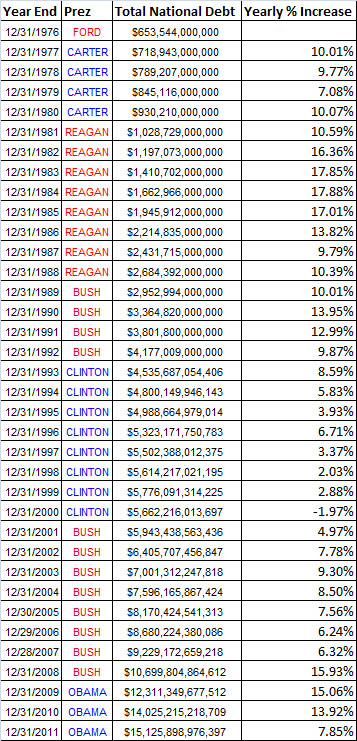
I created these two charts out of curiosity and really just as a reference for myself but thought I’d go ahead and publish them here.  This is the United States and the president is not a dictator which limits the usefulness of a simplistic comparison like this but it is still interesting and instructive. The president is the single most powerful individual in government.  They set the tone and provide the leadership that moves policy one direction or another. 

Since republicans are breathlessly criticizing the president for increasing the national debt and claiming, as usual, to be the party of fiscal responsibility, this data seems especially relevant.  To put it simply, there is no historical basis for giving the republican party any credibility on the subject of decreasing our debt.  If past performance is any indication of future results, we should expect the opposite.  At least over the course of my lifetime debt has grown much faster under republican presidents than under democrats.

Reagan is the one who really jumps off the page here; the deified standard bearer, universally praised for being the ultimate crusader against big government, and yet, no president in recent history has even come close to exploding the national debt in the way he did.  More than just an actor, Reagan must have been a master of mass hypnosis, as even in death millions of Americans have a completely inaccurate view of his presidency.  

The fact that the hero of the American right is someone who managed to preside over a debt increase of 189% tells you a lot about the modern American right.  I think it's no coincidence that this hero was a professional actor.  He ushered in the ultimate political con-job, “trickle down economics”, a wet dream for economic elites that was so cynical even George H.W. Bush referred to it as Voodoo Economics. It almost feels like a cruel joke that a republican presidential candidate is able to sell this same failed formula thirty years later.  I am continually amazed at how there never seems to be any real political consequences for republicans when their ideas and policies fail miserably.  

Monday, October 15, 2012

Our Cartoonish Electorate


Its election season which means every few hours a graphic or post like the one above pops up on my Facebook news feed.  As a native and resident Texan whose friend list is full of other Texans, almost all of the political posting falls somewhere along the spectrum between Obama is the anti-Christ and Obama wants to eat your babies.

To say the least there’s not much in the way of diversity of political thought ‘round here. That’s okay though.  As I’ve said before on this blog, political views are determined mostly by geography. You can’t necessarily hold the geographical group think phenomenon against people.

Now back to my picture.  See anything wrong with it?  Nobody on the Facebook thread that I copied it from seems to.  Instead, there’s just the usual chorus of people piling on with comments like “So True!” and “Amen!” and "Damn socialist!"

It should also be pointed out that several of the people commenting on the thread are pretty engaged politically.  So what’s wrong with the cartoon?  Well, everything.  Literally. 

Let’s look at each bucket in turn:

AIG
The AIG bailout occurred on September 16, 2008, three and a half months before Obama took office.  The federal government, under president George W. Bush, allocated $85 billion of U.S. Treasury funds so AIG could honor it’s collateral obligations. (Most of that money was paid to Goldman Sachs incidentally.)

Banks
The Emergency Economic Stabilization Act Of 2008 (aka the bank bailouts) was signed into law in October of 2008, at the request of the George W. Bush administration. $700 billion of U.S. Treasury funds were allocated to purchase toxic assets from the too-big-to-fail banks.  Again, two months before president Obama took office.

Housing
I can only assume that this one is supposed to represent the collapse of the housing bubble.  The housing bubble began to deflate in 2007 and the volume of subprime mortgage lending peaked between 2004-and 2006.  By mid to late 2008 the U.S. economy was in free fall, soon to be followed by the global economy.  Once again, all of this occurred before Barack Hussein Obama became president.

Autos
The initial auto industry bailout was initiated by president George W. Bush in December of 2008.  $17.4 billion of U.S. Treasury funds were allocated to prevent GM and Chrysler from going into what president Bush referred to as “disorderly bankruptcy”. Here's his speech announcing the bailout.  Obama did expand the auto bailout later in 2009, so we can at least give the Obama-hater who drew this cartoon a little credit there.  But once again, the initial policy was implemented before Obama became president.

There’s also a bucket that says “Ins.”.  I have no idea what that is supposed to be so I won’t comment on it.

So every single policy or event that this cartoonist is trying to attribute to Obama actually occurred while George W. Bush was president.  You try to point this out and without fail the reply is “When are you people going to stop blaming Bush!”. 

If this type of thing was a one-off occurrence I wouldn’t have bothered talking about it here.  But it’s rampant. It’s every day, all the time.  And I offer it up as further evidence that right wing, Obama-hating America lives in an alternative universe, an information bubble that is impervious to basic, factual understanding of real life, verifiable events.   As bit of a political loudmouth I feel like I’m in a constant game of whack-a-mole with the phantom creations of the conservative echo chamber. 

I’m only 35 years old so maybe my historical sample size is too small, but the level at which this president gets blamed for all of the disastrous policies and consequences of his predecessor  feels unprecedented. The blind and hysterical hatred that is directed at him is wildly disproportionate to his accomplishments or lack of.  Regardless of one’s political leanings cartoons like the one above shouldn’t be going viral on social media.  Even a casual familiarity with the news would be enough for anyone to quickly see how ridiculous and misleading it is.  But here in the land of mass political amnesia, with our oh so selective interpretation of reality, this thing becomes gospel.

Regarding the person who posted this on Facebook, I kindly pointed out the inaccuracies and said what I often say in these cases:  If you guys are upset with stuff that He Who Must Not Be Named George W. Bush did why don't you just say so and use HIS name and put his picture on your cartoons?  You can imagine the response I got.

Friday, October 12, 2012

In Which I Agree With Bill O’Reilly


Saturday night the wife and I sprang for the $4.95 to watch the live internet streaming debate between Bill O’Reilly and Jon Stewart.  (Yes, we are party animals.)  One of the questions was:  “What do you think is the most fundamental problem with the public political discourse?”  O’Reilly’s answer: “Capitalism.”

It’s a good thing I was drinking because I might’ve collapsed in surprise at being in total agreement with ‘The Mayor Of Bullshit Mountain’. O’Reilly explained how lucrative it is to be a professional hater – an assassin – as he called it.  Now granted this is a bit like Ronald McDonald pinpointing French fries as the culprit behind America’s obesity problem, but he has a point.  The highest paid media personalities are the ones most adept at working their audience into a blind rage every evening.   

Bill O’ even suggested that a lot of times these haters don’t even believe the stuff they are saying, they’re just playing to their crowd.  I’ve said as much before myself.  The problem is that their allegedly massive audiences actually do believe what they are saying.  And these are the people voting in primaries and driving the discourse. 

Although I basically agree with Bill here, I think he’s only partly correct.  Capitalism, or the fact that the haters command these huge followings, is more of a symptom than the root cause.  I blame the people who dial in to these pontificating buffoons more than the pontificating buffoons themselves.   Taken one step further, I blame an educational and cultural system that produces such a large number of people who are only interested in tuning in to media that reinforces their pre-existing beliefs and caters to their prejudices and biases.  

The haters are just offering what the market demands.  There is so much anger and frustration out there.  The haters tap in to that and channel it in ways that are appealing to their listeners/viewers. It’s really mental laziness and lack of intellectual curiosity that make the success of the haters possible.

Hard news doesn’t sell and thinking for one’s self takes some effort which is why both are notably absent from the national public dialogue.  The cable and radio haters don’t offer much in the way of actual news and they do your thinking for you.   In a complex and diverse world with complex and diverse problems they offer simple explanations and even simpler solutions.  Add in their masterful ability to play to the innate human need to feel victimized and you have a winning formula.

So yes, O’Reilly is right.  Capitalism is dragging down the public discourse.  But capitalism comes down to supply and demand and it’s obvious there is huge demand for dumbed-down, vitriolic, one-sided ‘info-tainment’.  I hate to say it but my conclusion would be that the public discourse has degraded because the public itself has.

Monday, October 8, 2012

A 'Job Creator' Speaks

A Bloomberg article that I read today sent me to the blog of former American Airlines chairman and CEO, Bob Crandall.  The piece was about economic inequality in the US, a subject that I think is THE major issue of our time, and mentioned that even a successful, wealthy, and well-respected ex-CEO like Crandall was decrying the negative impacts of so much wealth concentrated at the top.  Naturally this piqued my interest and I promptly made my way over to his blog and read the most recent dozen entries or so.

Sure enough, this one-percenter makes some of the same observations and points that have seemed so obvious to me and many others.  What makes it noteworthy is that this is yet another prominent business leader making statements that are blasphemous to American right wing ideology, an ideology that probably 40% of the population takes as gospel, even as they are ravaged by the real-life consequences of its policies.  It’s one thing for a bearded hippie living in a tent near central park to point out that the US is turning into a banana republic, but something else entirely when ex CEOs of iconic American corporations and billionaire investors do it.

I appreciate and support the Occupy Wall Street movement.  These are people who, regardless of their image or social status, at least understand the source of the problem.  They get who’s screwing them.  They are vocal and visible and reminiscent of the real people-power type of mass movements that were so successful at initiating social change in the 1960s.  That is a great thing.  And one conclusion that I’ve come to after five or six years of studying politics and power like a mad scientist is that positive social change starts from the bottom up.  The people influence the leaders who are in a position to make public will a reality.

So Occupy is great, but the mere fact that most of them are students or people who are otherwise not working a nine-to-five makes them easy for the media and much of society to marginalize.  Sadly, there are millions of people in this country who just don’t think you count as a real human being with valid concerns unless you’ve had to “make a payroll”.  An entire political party subscribes to this view.  Nevermind the absurdity that only a small percentage of people who belong to that party actually meet their own criteria for being a worthy citizen. 

Bob Crandall is not the kind of person that the usual suspects can assail with the sneering “take a shower and get a job” line of attack.  When someone of his social standing is willing to put aside their own narrow self-interests and openly discuss truths that are uncomfortable and inconvenient to his class, I find it encouraging and I think it should be applauded.  The cry of “class warfare” is used by the very people who are successfully waging it. It’s nothing more than an attempt to shut down the discussion and far too often it works.  But when people like Crandall lend their voice to this cause, the efforts to turn it into a thought crime become less effective.

Other business leaders have weighed in on this issue, most notably Warren Buffett who made the statement: “There’s class warfare alright, but it’s my class, the rich class, that’s making war, and we’re winning.”  There’s also venture capitalist Nick Hanauer who gave the must-see TED talk where he refers to  trickle down economics as the biggest political con in history.   And the big boogeyman of the American right, super-capitalist billionaire George Soros, also has a few things to say on the subject.

Buffett, Hanauer, Soros, and Crandall are not the kind of people who can be brushed off by so-called conservatives as shiftless government dependents or socialist agitators.  Although to be fair, I’ve seen them try, usually with pretty laughable results. (Ex: “But Buffett is just an investor, he hasn’t created any jobs!”…What? So you mean it’s possible to become the wealthiest human being on earth and not be a ‘job-creator’? Hmmm...)

Each of these individuals has directly or indirectly advocated policies that would personally cost them money.  They’ve acknowledged that the system is rigged in favor of people in their position at the expense of people who are not.  They’ve admitted that such an imbalance of power and wealth has serious negative consequences on society.  Why?  My guess is that they feel a sense of responsibility and obligation to the country that allowed them to achieve such dramatic success.  Does it upset others in their social class who do not feel that sense of responsibility? Of course it does.  There will always be those who, despite their obscene wealth, think of nothing but getting more, whatever the impact that has on everyone else.  Unfortunately, in terms of the one-percent they are in the majority.  And that makes the Buffetts and Crandalls out there even more important to those of us who would like to see positive change.

Getting back to Bob Crandall’s blog, here are some of the points he brings up which I think are spot on:

  •  26 of the country’s top CEOs personally made more money than their company paid in taxes in 2011.  This is absurd and is a perfect example of the unfairness of tax laws and the need for changes   in corporate governance rules.
  •  In order to address major problems and the looming national debt, the very wealthy and corporations need to pay higher taxes.  The Bush tax cuts for incomes over $250K should be allowed to expire and the estate tax should be re-instated.
  • The right likes to complain that the corporate tax rate is too high, 39% they say.  But statutory tax rates are different than effective tax rates and the effective rate (the one that actually reflects the percentage paid) of US corporations is roughly 12%.  As an example, Apple, now the world’s richest company, only paid a 9.8% tax rate in 2011.
  •  The US government needs to spend more money in the short term to stimulate demand. Our infrastructure is outdated and crumbling and with interest rates at roughly 0%, now would be a great time to invest in some much needed improvements and put some people to work.
      I predict that as time goes on and the gold-plated, diamond encrusted, elephant in the room becomes even harder to ignore, more people like Bob Crandall will look beyond the self-interest of their own socio-economic class and speak up on behalf of the greater good.  Then maybe we can quit pretending that this is a discussion about envy and treat it like the very real threat to American democracy that it is.

Romney - Man Of The People

What kind of political blowhard observer would I be if I didn’t say something about Wednesday night’s presidential debate?  Meant to do this sooner but we’ve had technical difficulties for over a week now.  Very spotty internet service from AT&T broadband.  I’m sure it’s the government’s fault somehow.

Anyhow, I’ll try to be brief.

This debate was a snoozer.  One candidate must have agreed with me because he looked like he needed a nap. He seemed bored and a little irritated to even be there.  That would be our president.  The other guy came off like he’d been downing Red Bull all afternoon.  If they were trying to provide contrast they succeeded in that regard.

So Romney “won”.  Obama was blindsided and frankly, so was I.  The Romney who has been campaigning the last twelve months was not the same guy who was on stage Wednesday night. Not in demeanor, but more importantly, not in policy.  Or so he’d have us believe. It’s pretty easy to win a debate when you change your major policy positions on the fly and simply deny any of the negative things associated with what you’ve proposed. I can’t blame Obama too much. I have no idea how you are supposed to debate with that.  It’s frowned on to look your opponent in the eye and say “Governor, with all due respect, you are completely full of shit.”

Romney started off with the standard right wing chorus: regulations and taxes are killing the economy.  Less than fifteen minutes later we got to hear about how he loves regulation, especially for Wall Street.  Then there was the big tax discussion that took up most of the debate.  Romney says he will cut tax rates, especially for the wealthy, but don’t worry.  He promises that that nobody, especially the wealthy, will actually pay less taxes. So don’t be concerned about those tax cuts impacting the deficit.  Healthcare was a big topic too.  Romney of course will ‘repeal Obamacare on day one’.  But again, don’t fret. He’s keeping all the good parts.  Romney miraculously turned into Mr. Middle Class seemingly overnight.  He was determined to use the phrase “middle class” more than Obama. It would’ve made a good drinking game.

In short, it appeared to me that Romney’s strategy for beating Obama…was to sound more like Obama.  A man in love with regulation who is determined to see that the wealthy don’t pay one less penny in taxes because they are ‘doing just fine’, who thinks of nothing but the well being of the middle class and wants to make sure that health insurance companies can’t deny people with pre-existing conditions. 

Look – if the republican strategy for winning the presidency is to pose as a democrat, we are winning. 

I won’t bother with all the factual inaccuracies (one count had Romney at 27 lies misstatements in 38 minutes) because anyone can look that up.  But even if he was sincere, here is someone claiming that the United States can solve its debt problem, create twelve million jobs, give everyone awesome healthcare, and nobody anywhere will have to sacrifice a thing.  And we all get a free pony. 

Maybe in a country where football and little honey boo boo get more attention than politics people will fall for this all gain no pain fantasy.  Maybe nobody will dig into the details and see that Mitt Romney’s healthcare “plan” does indeed prevent insurance companies from discriminating against people with pre-existing conditions – but only for people who have not had a lapse in insurance coverage, a provision that is already law. In other words, no change there.  Maybe nobody will pick up on the fact that this person who claims to be so serious about lowering the deficit and debt never denied that his proposal calls for increasing the already outrageous military budget by $2 trillion dollars.  Maybe nobody will ask how that gets paid for (and find out that it doesn’t).  Maybe nobody will question the mathematical impossibility of cutting taxes by 20% without lowering actual revenues.  Maybe they’ll overlook the fact that eliminating every single loophole and deduction would still not make up that 20%.  Maybe nobody will scratch their head at how the guy who has spent his entire campaign breathlessly decrying regulation just stood behind a podium in front of 17 million people and literally said the words: “I like regulation!.” Maybe nobody will note how utterly ridiculous and laughable it was, when asked for a single specific thing he would cut to lower the deficit, all he could come up with was to defund Big Bird.  Maybe they won’t realize that funding for public television and radio makes up a whopping .00014% ($135M) of the total budget, or question why he wouldn’t touch the $7 BILLION of government subsidies that go the oil companies.

Sorry for all the maybes but it would take a massive amount of cognitive dissonance and selective listening to even begin to think that is a serious person with a meaningful vision.

Yes, Obama flubbed the thing and ignored a wagon load of low hanging fruit. I think part of it was falling victim to the baffled by bullshit tactic that was deployed against him but that’s no excuse for his terrible energy level and demeanor.  As someone who remains convinced that a Mitt Romney presidency will be George W. Bush Act III, I sincerely hope that next time the president is rested and better prepared to deal with a guy who will say anything on the fly.

Saturday, September 22, 2012

You Sort Of Built That


Once upon a time I considered myself a conservative republican. Political views are like religious views in that you are more or less born into them.  Geography and environment determine both.  Ideas are imprinted onto our minds before we’ve had a chance to develop strong critical thinking skills. We hear things over and over again and believe them.  We want to belong to our tribe, etc.  It’s only natural. I was raised in East Texas and my political views up until my mid-twenties reflected that. 

My political change of heart happened for a combination of reasons but I think the biggest factor was just spending enough time out in the real world making a living and paying bills.  To be perfectly honest I just didn’t pay a lot of attention to this stuff until my late twenties. Around that time I started getting a better understanding of how the world actually works and started looking deeper into politics and power and I shifted from right to left on the political spectrum.  There were beliefs I held that just didn’t square with the reality I saw day to day and eventually I had to admit it to myself and adjust accordingly.

There were a number of issues that I realized were just plain wrong and maybe addressing each one individually is an idea for future blog entries but the main one could be summarized like this:

 “If you are rich, poor, or somewhere in between, it’s your own fault.”

That’s really the big myth.  The rich deserve to be rich and the poor deserve to be poor because “the market” and their own personal talent and hard work (or lack of) is what got them there.

Lest this post be misconstrued as a product of disappointment or jealousy resulting from personal failure, allow me to dispel that now.  I have exceeded my own expectations of success – and my expectations were high.  It was not a lack of personal achievement that caused my change of heart. It’s been the opposite.  My personal journey through the stages of achieving reasonable economic success has been a large part of why I started questioning the truth of the statement above.

To be sure, there is some truth to the claim that one’s fortunes or lack of are their own doing.  I’d estimate that the claim is about 50% valid.  When looking at the sum total of factors involved with determining an individual’s socio-economic status, I would argue that personal talent and determination account for maybe half of the total.  The other half can be summarized in a single word:  luck.

If you are uncomfortable with the word luck we can also call refer to it as circumstances that are out of one’s control.

If you happen to be born into a stable, loving, financially secure family, your odds of success are immediately much higher than someone who was not.  If your parents happen to be bright people and intelligence is in your genetic makeup even better.  If your parents happen to be not just financially secure but wealthy, even better. If your parents happen to be not just wealthy but also well connected and powerful in the community, even better.  And so on.  Warren Buffett refers to this as the “Ovarian Lottery” and the role it plays cannot be overstated.  As the second wealthiest person on Earth he acknowledges that being born in the right place at the right time with the right kind of mind was a tremendous factor in his success.  He realizes that not being born to a crack head mother or alcoholic, gambling-addicted father was not the result of good decision making skills on his part.  Being raised in a comfortable suburban neighborhood in Omaha, Nebraska as opposed to a housing project in Compton, CA was not based on any tenacity or talent that he possessed. It was chance, pure and simple.  The idea that we all get an equal start is ludicrous but it’s a comfortable delusion for people born with every possible advantage.

And luck goes far beyond the accident of birth.  There are countless examples of people who have followed all of the rules, worked hard, done everything you are supposed to do and still struggle to get by.  The fact is that there are innumerable factors outside of one’s personal control that shape their economic outcome.  The big recent example would be the millions of people in the United States and all over the world who have had their financial lives shattered because a handful of greedy con-men from Wall Street wrecked the whole system. 

Thinking about my own case, yes there are certain things I’ve done right but there are also situations that just happened to work out for me that could have easily gone the other way and made a big difference.  I’ve been fortunate in ways that went beyond anything accomplished by own individual efforts.  Nobody is truly self-made.  Even with rags to riches type stories someone, somewhere gave someone else a chance.  Other people helped that person succeed.

Then there are the various features of society that make success possible: public education and universities, transportation infrastructure, law enforcement, fire departments, the judicial and legal system, patent protection, safe drinking water and food standards (and the means of enforcement), a national defense, and the list could go on.  Providing all of this to three hundred million people is not free.  As wealthy venture capitalist Nick Hanauer put it, if zero government, taxes, and regulation were truly the ideal environment for thriving businesses, places like Somalia or the Congo would be the home to the world’s most successful companies.

I do think there is a realistic and reasonable path to a comfortable life for almost anyone who has the capacity to learn, work hard, and overcome the peer pressure to waste money on unneeded junk.  Our decisions do go a long way towards shaping our future but it’s too simplistic to think that personal effort and ability are the only determinants of economic outcomes. A lot of people at the very top would like us all to swallow that (especially those like David and Charles Koch, the Walton heirs, and others who inherited dynastic wealth from daddy) but I think that’s just so they can absolve themselves of any responsibility to contribute and give back to the society that made their opulent lifestyles possible.

(Note: Economic mobility can be measured by how closely a son’s earnings are correlated to his father’s earnings.  By this measure France, Germany, Sweden, Canada, Finland, Norway, and Denmark are all more upwardly mobile than the United States.)
Monday, January 23, 2012

Stay Thirsty My Friends

About twelve years ago on a typical sweltering summer evening, I sat on the steps leading up to my apartment sipping on a lukewarm Coors Light (nectar of the gods at that time) longneck. Lukewarm because during July in Texas if you don’t down it in less than two minutes that’s what happens. I probably shotgunned the first one for that very reason but I was taking it easy on number two. There was no hurry. I had nowhere to be, nothing to do. I was almost always grateful for that condition back then. Not that I had a bustling social life. By then I had almost no social life. I’d phased it out over a number of years for reasons that were surely misunderstood by those who I ran with for so long before.

I needed to explore and expand. I needed to start figuring out who I was and who I would be. I needed plenty of solitude and free time; time to dabble in loneliness and introversion and unfamiliarity. In short, time and space for an inward journey that had begun years before but was constrained by old habits and roles.

It’s fascinating to feel yourself changing as it happens. To notice things that were once so deadly important to you become not that important at all. To watch your previous hopes and fears dissolve and be replaced by new hopes and fears; in my case, ones that were now mostly vague and undefined.

Back in those days – I call them my apartment days – there were some very large and looming questions, intimidating but exciting. Will I graduate with a high enough GPA? Where will I live? What will my job be? How will I get that job? There will be a girl. Who will she be? What will she be like? How will we meet? Have we already met?

These are fun questions. It’s only natural for there to be a little anxiety around questions like these, and for me there was, but more importantly there was just an underlying sense of knowing that it was all going to work out. I never knew how. I just knew it would work out. I never stressed myself over it too much. There was something beautiful about not knowing. That little bit of anxiety was really more like anticipation.

Many a summer evening was spent sitting out on those steps, drinking beer and letting my thoughts wander where they may. Reflecting on where I’d been, looking out into a vague outline of the future. I always felt like I was ‘on my way up’ during that period, which made sense because as a college student that is really the only direction to go. And that is a very free feeling. Those college days had their stressors. Make no mistake about it. There were exams to study for and cumbersome, time consuming projects with approaching deadlines - always last minute undertakings for me. But there was also a certain wide open, anything is possible feeling of freedom that you really don’t appreciate when you actually have it.

That’s one of the things they don’t tell you when you are young and on your way up. They don’t tell you that that nothing-to-lose feeling, though it may have a bit of an edge, is actually a very worthwhile state of being. It’s a bliss that will go away once you’ve established yourself, acquired the things you set out to acquire, and generally achieved what you set out to achieve.

Sitting on those apartment steps ruminating away the summer evenings I often felt like I was starting to figure things out. It is so cliché but so undeniably true that when you’re young, totally inexperienced in the world, and know next to nothing, you really do think that you know it all. And that’s probably so because life hasn’t had time yet to confront you with what you don’t know. It’s easy to be convinced of your own brilliance when it’s been all theory and no practice. Nonetheless – it’s still a sublime state, a necessary one, and one that anyone over the age of thirty will probably find themselves missing at some point in their lives.

Which I think leads me to the point of this meandering, out-of-practice, disjointed attempt at an internet age cave scrawling. When I was sitting there nursing that watered down beer twelve years ago, I really had figured out a lot. I knew change was coming. I knew I’d get to where I needed to be in life and that worrying too much about it was a waste of energy. I knew that if I completed the immediate steps that were there in front of me that the future would work itself out. The Universe would provide. It always had.

But there was at least one epic truth that I was completely blind to. Success and achievement come with a price – a heavy price if we are honest with ourselves. And that price is a freedom and light-heartedness that can only exist when you have nothing to lose; when you have your whole life in front of you, when things are more theoretical than practical, more whimsical than utilitarian.

I have a lot now, in every sense of the word. I’ve accomplished what I set out to accomplish. I feel both lucky and grateful for it. But I also have a lot to lose now. And I’m old enough to see how fragile life really is. How it can go so quickly, and how forces that are completely out of my control could take it from me.

Do I long to go back to being twenty five, sitting on a balcony drinking beer with scarcely a care in the world and not much to lose? Not for a second. This is a different phase of the journey, with different happiness and different anxieties. I didn’t see the flipside of adulthood and success when I was twenty five but I can look back on some of my concerns from that time and be comforted and reassured about what lies ahead. Those old questions have been replaced with new ones that are no less intimidating or significant. But I have the experience now to know that worrying about them is not worth my precious time. Now, just as then, the Universe will provide. And knowing that is one of the things that make me smile when I sit out on the back porch and have a beer these days.